

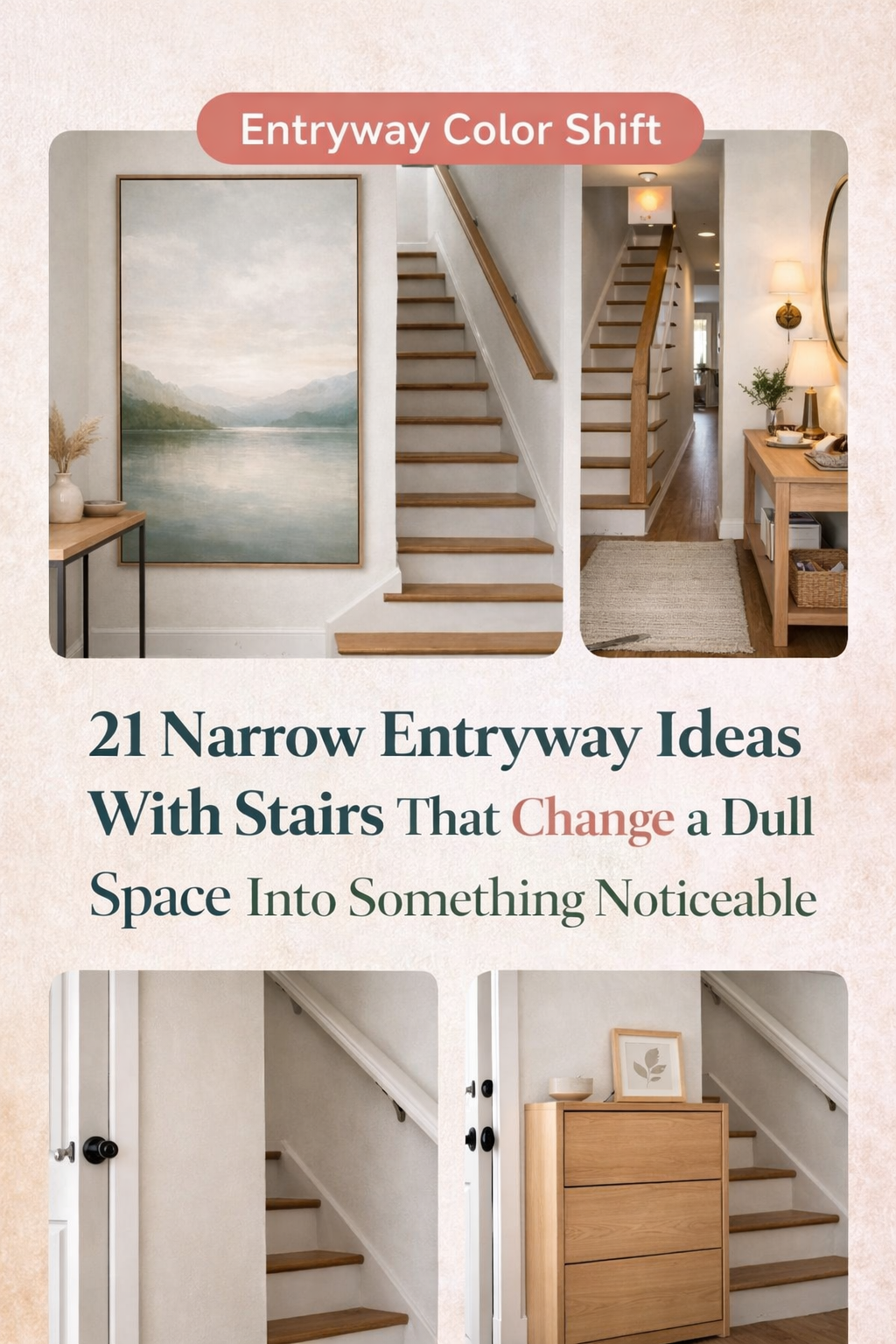
A narrow entryway with stairs can be useful, stylish, and easy to live with, but only if the layout is handled well. This area has two big problems. It is usually tight, and it has to do a lot at once. It welcomes people in, handles daily traffic, stores shoes and bags, and connects the front door to the rest of the house.
That is why bad choices show up fast here. A deep table eats up walking space. A dark paint color can make the staircase feel heavier. Too many baskets, hooks, and decor pieces can turn the whole entry into a visual traffic jam.
The best narrow entryway ideas with stairs solve real problems first. They keep the walkway open, use vertical space, make the stairs feel connected to the entry, and add storage without bulk. They also help the space feel brighter and more pulled together from the moment you walk in.
This guide covers 21 smart ideas that work in real homes, not just pretty photos. These ideas are especially useful for small foyers, townhomes, compact hall entries, split-level homes, and narrow front doors that open right beside the staircase.
1. Use a Slim Console Table That Leaves Breathing Room
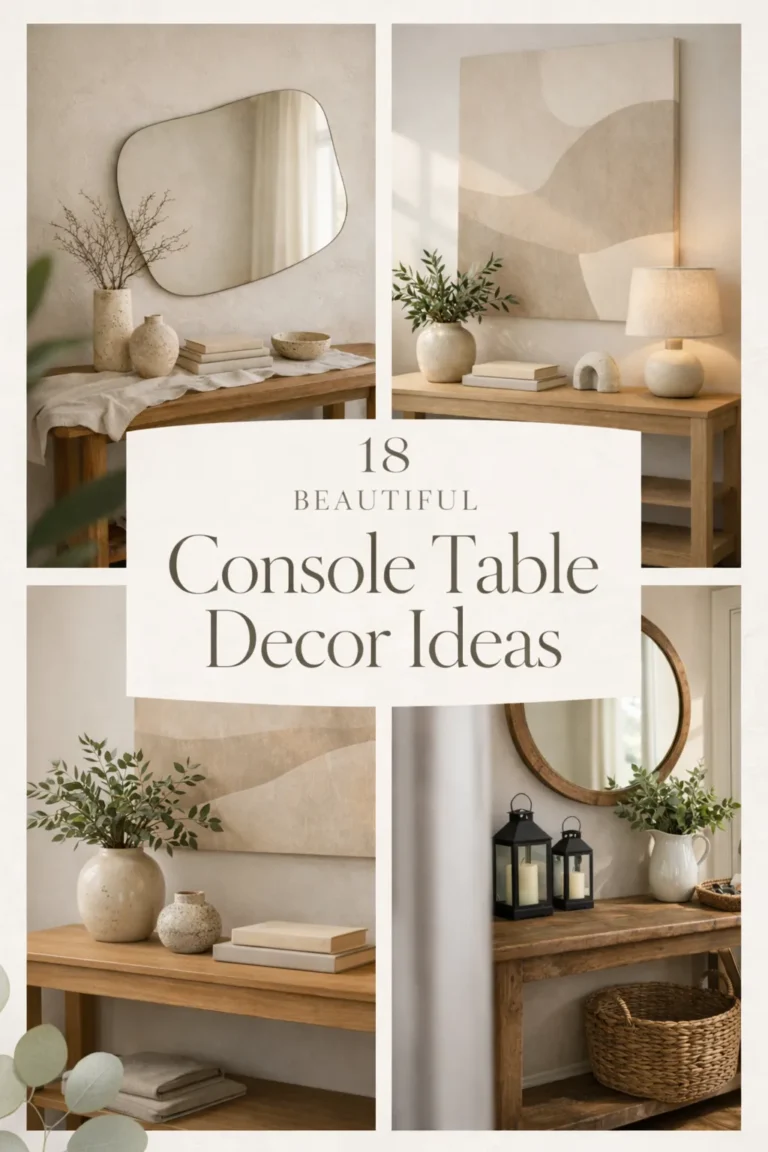
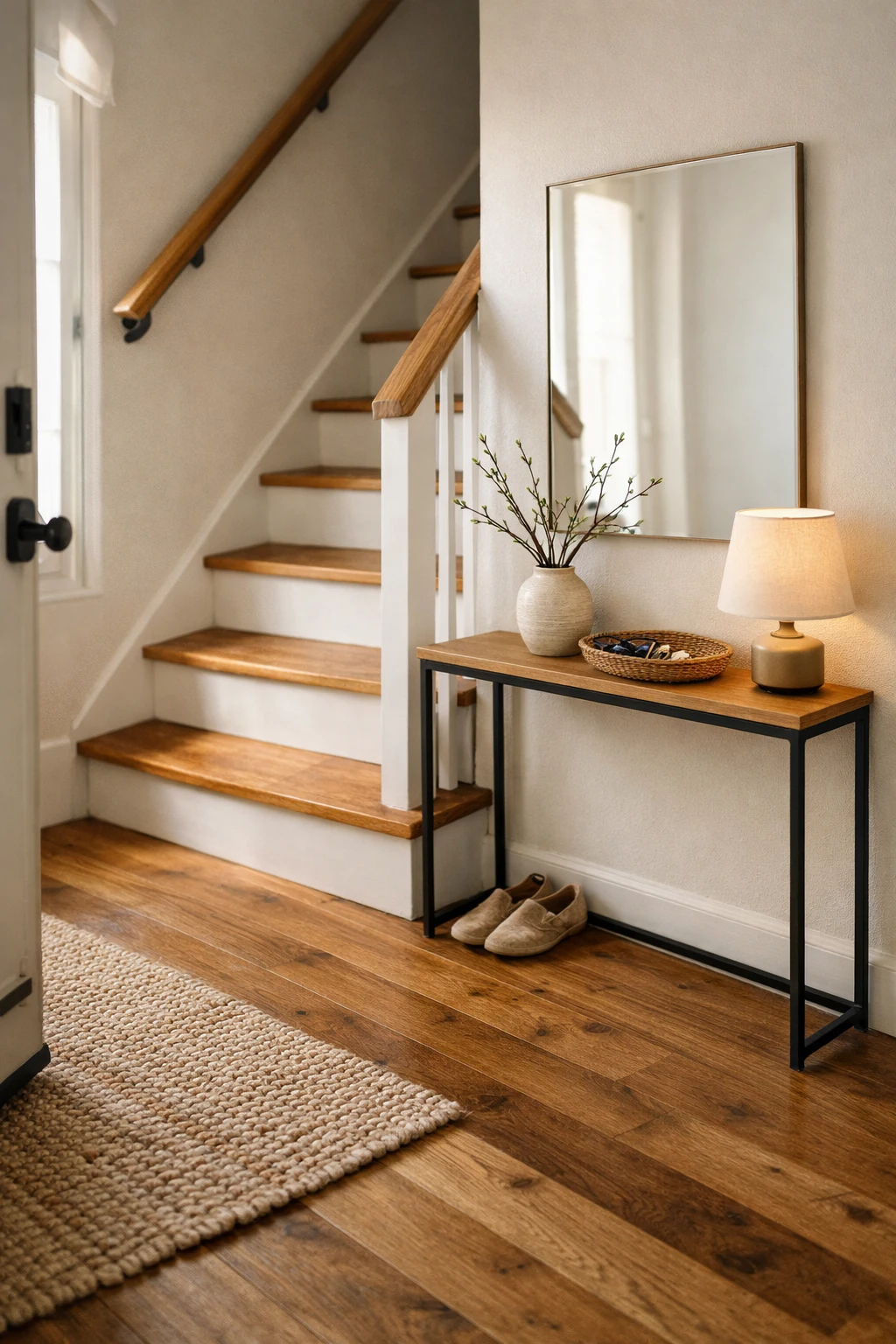
A narrow console table can make the entry look finished, but only if the scale is right. In a tight entryway, the table should be shallow enough that people can pass through without turning sideways. Around 8 to 12 inches deep is usually the sweet spot.
This gives you a landing spot for keys, sunglasses, and mail without stealing the walkway. Open-frame tables tend to work better than chunky wooden pieces because they look lighter.
A few strong options include:
- A slim wood console with one lower shelf
- A metal frame console with a thin top
- A floating shelf used as a mini entry table
- A waterfall-style console with clean lines
Keep styling simple. A lamp, a small tray, and one vase or branch arrangement is enough. In a narrow entry, more decor does not make it better. It usually just makes it crowded.
2. Hang a Mirror to Make the Space Feel Wider
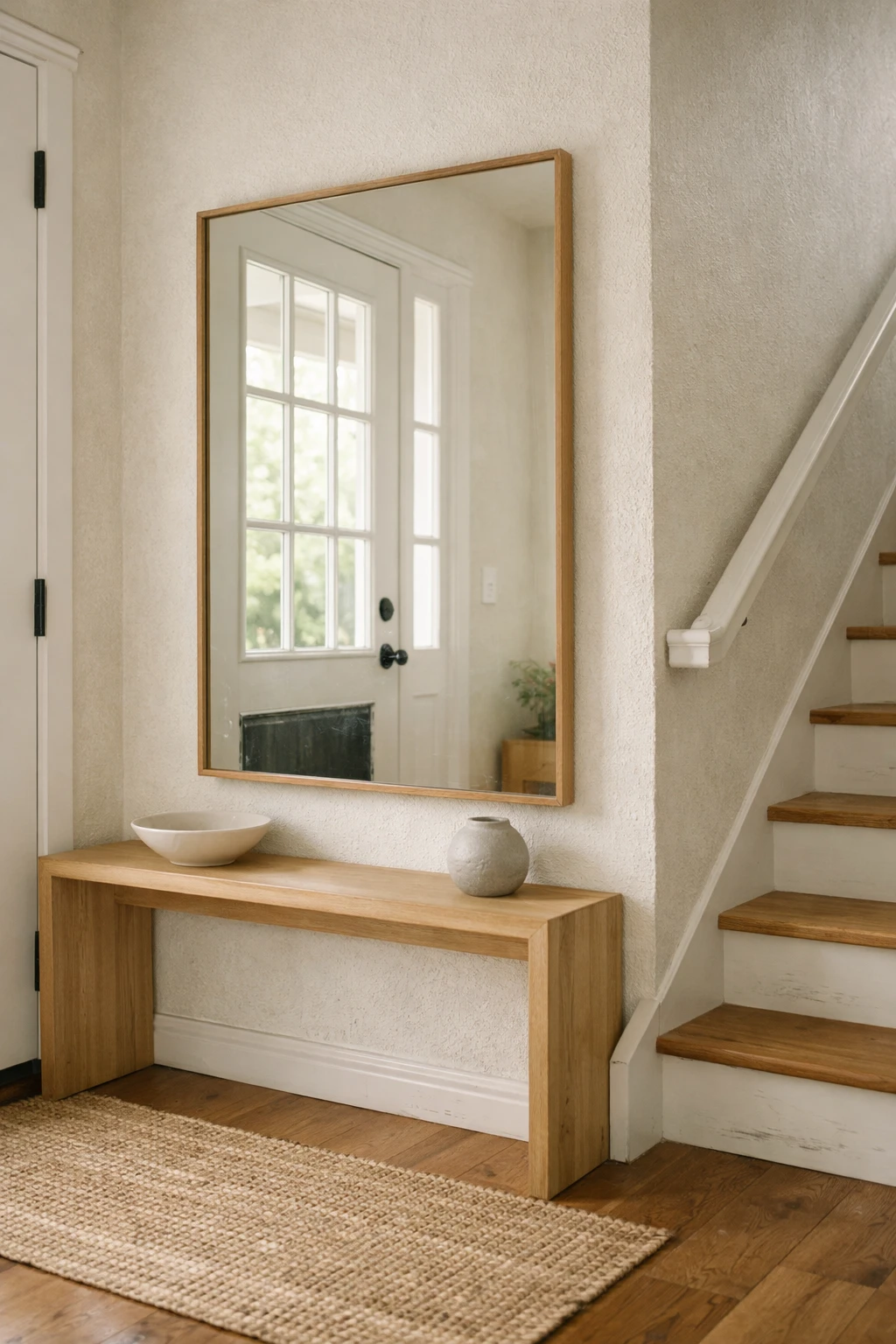
A mirror is one of the easiest ways to help a narrow stair entry feel more open. Stairs add a lot of lines, angles, and visual weight. A mirror helps break that up and reflect light back into the space.
This works especially well if the front door has glass panels or if there is a nearby window. Even a little daylight can make a big difference once it bounces off a mirror.
Choose the shape based on the look you want:
- Round mirrors soften sharp stair lines
- Tall rectangular mirrors feel neat and classic
- Arched mirrors add a little softness without feeling fussy
If you are hanging a mirror above a console, keep a little breathing room between the top of the table and the bottom of the frame. If there is no room for a table, a full-length mirror on a nearby wall can still do the job well.
3. Turn the Under-Stair Area Into Hidden Storage
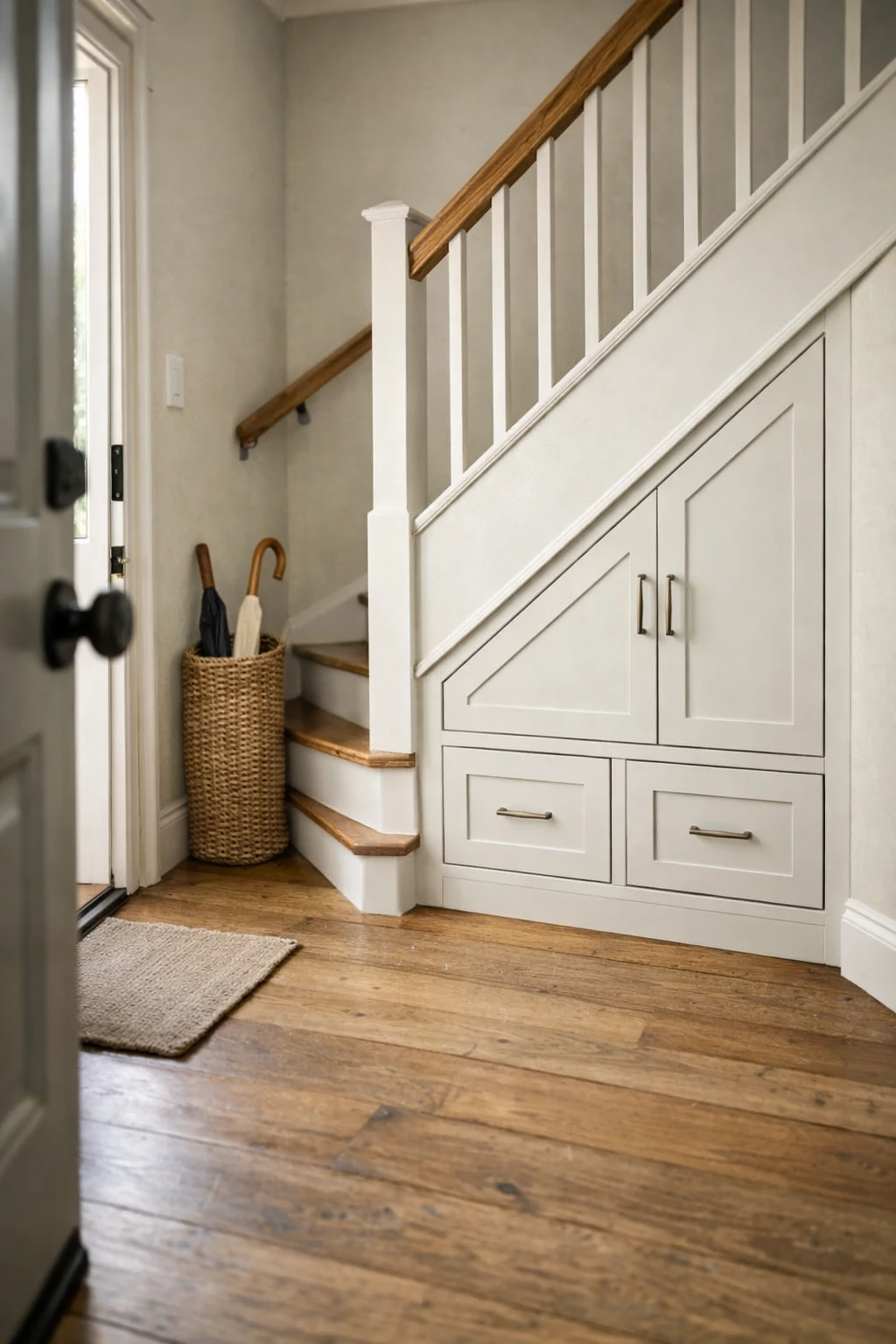
If the staircase starts right in the entry, the under-stair zone is often the best storage opportunity in the whole area. Ignoring it is a waste.
This spot can hold:
- Pull-out drawers for shoes
- Cabinets for bags and cleaning tools
- Closed storage for seasonal items
- Small cubbies for everyday grab-and-go gear
Closed storage usually looks better than open storage in a narrow entry. Open cubbies sound practical, but they often end up full of random shoes, loose hats, and messy bags. If the goal is a calm first impression, doors and drawers do more work.
Even one built-in cabinet under the stairs can remove the clutter that usually piles up near the door.
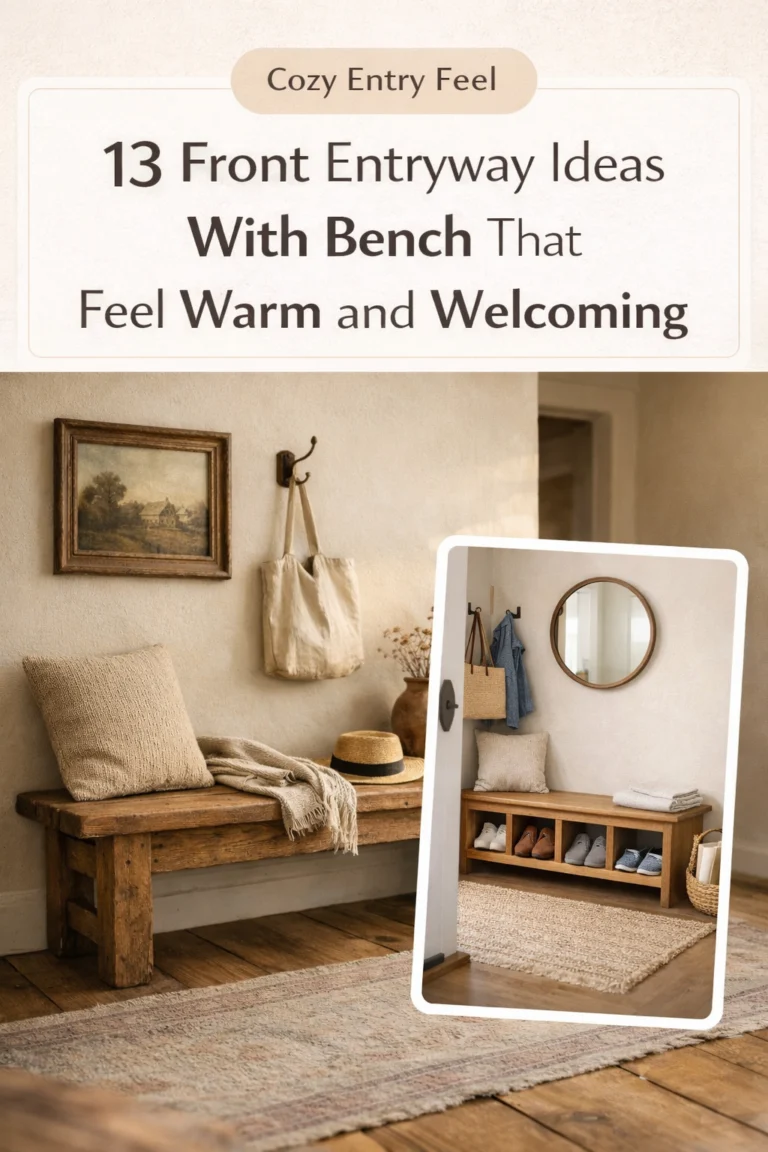
4. Add a Narrow Bench That Actually Fits the Space
A bench is useful, but only when it fits the layout. Too many people buy a bench that is too deep, too heavy, or too wide for the entry. That makes the space harder to move through.
A narrow bench works best when you need a spot to sit while putting on shoes or when the household uses the entry as a daily drop zone. Look for a bench with a slim footprint and open legs, or choose one with hidden storage inside.
Good places for a bench:
- Against the wall opposite the stairs
- Tucked under the lowest safe part of the stair line
- Beside the front door if clearance allows
Top it with one simple cushion or leave it bare. The goal is function, not bulk.
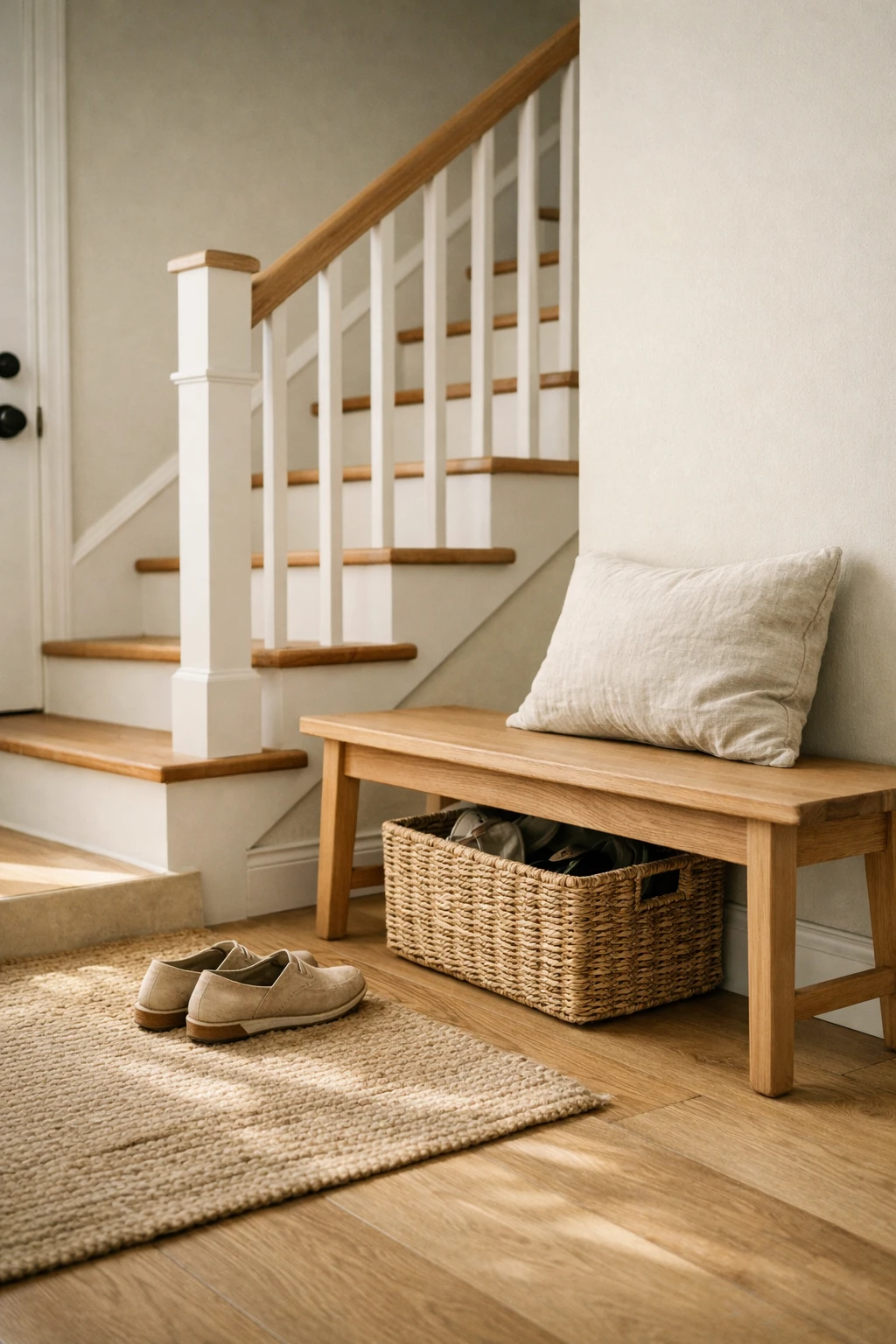
5. Use Wall Hooks Instead of a Full Coat Rack
A standing coat rack can eat up valuable floor space in seconds. In a narrow entryway, wall hooks are usually the smarter choice.
Hooks keep the floor clear and can be placed exactly where the family needs them. They also work well beside stairs, where floor space is often broken up by railings or awkward angles.
To keep this idea from looking messy:
- Use fewer hooks than you think you need
- Space them evenly
- Stick to one finish, like black, brass, or wood
- Limit what stays there every day
If every family member hangs three coats, two bags, and a hat in the entry, no styling trick will save it. The setup has to match real life, but it also needs limits.
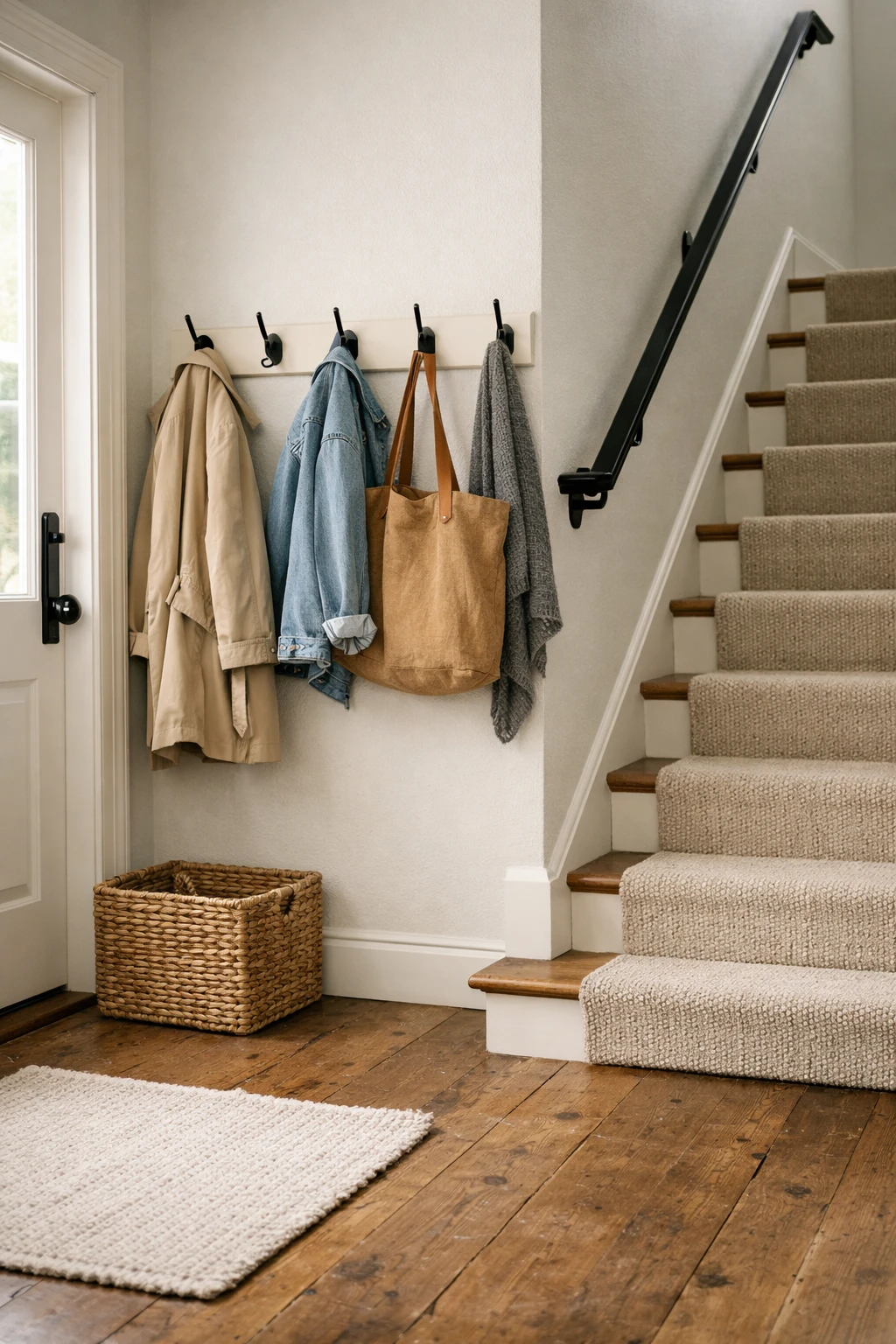
6. Paint the Walls and Stair Area in Light, Soft Tones
Color has a huge effect in a small entry, especially when stairs are involved. Dark wood treads, painted railings, and stair shadows can make the area feel tighter than it is.
Light wall colors help reduce that heaviness. Soft white, warm beige, pale greige, and muted taupe tend to work well because they reflect light without feeling cold.
This does not mean everything has to be white. It means the wall color should help the staircase feel less dominant.
A few smart approaches:
- Paint the walls and trim the same soft tone for a smoother look
- Use a lighter wall color if the staircase is dark stained wood
- Keep contrast low if the entry is very tight
The smaller the space, the more you benefit from visual calm.
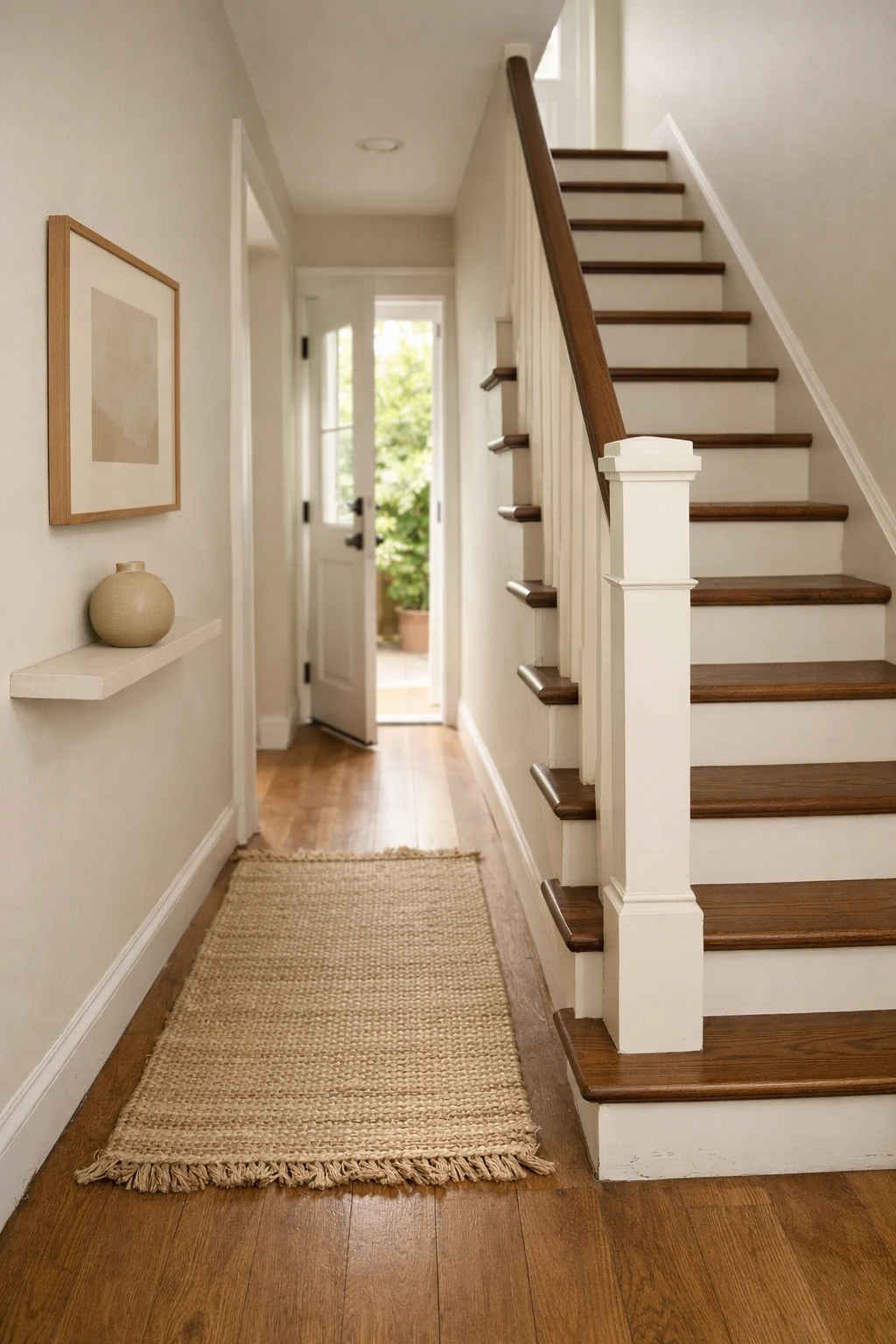
7. Add a Runner on the Stairs to Soften the Look
A stair runner can do more than protect the steps. It can also make a narrow entry feel warmer, quieter, and more finished.
Bare stairs can look harsh in a small entry, especially if the surrounding walls are plain. A runner adds softness and helps the staircase feel like part of the decor, not just a structure cutting through the room.
For narrow entries, the best runner styles are usually:
- Simple stripes
- Subtle patterns
- Soft neutrals
- Low-contrast designs that do not overpower the space
If the entry already has a lot going on, skip loud prints. A busy stair runner plus hooks, baskets, shoes, and wall decor can turn into noise fast.
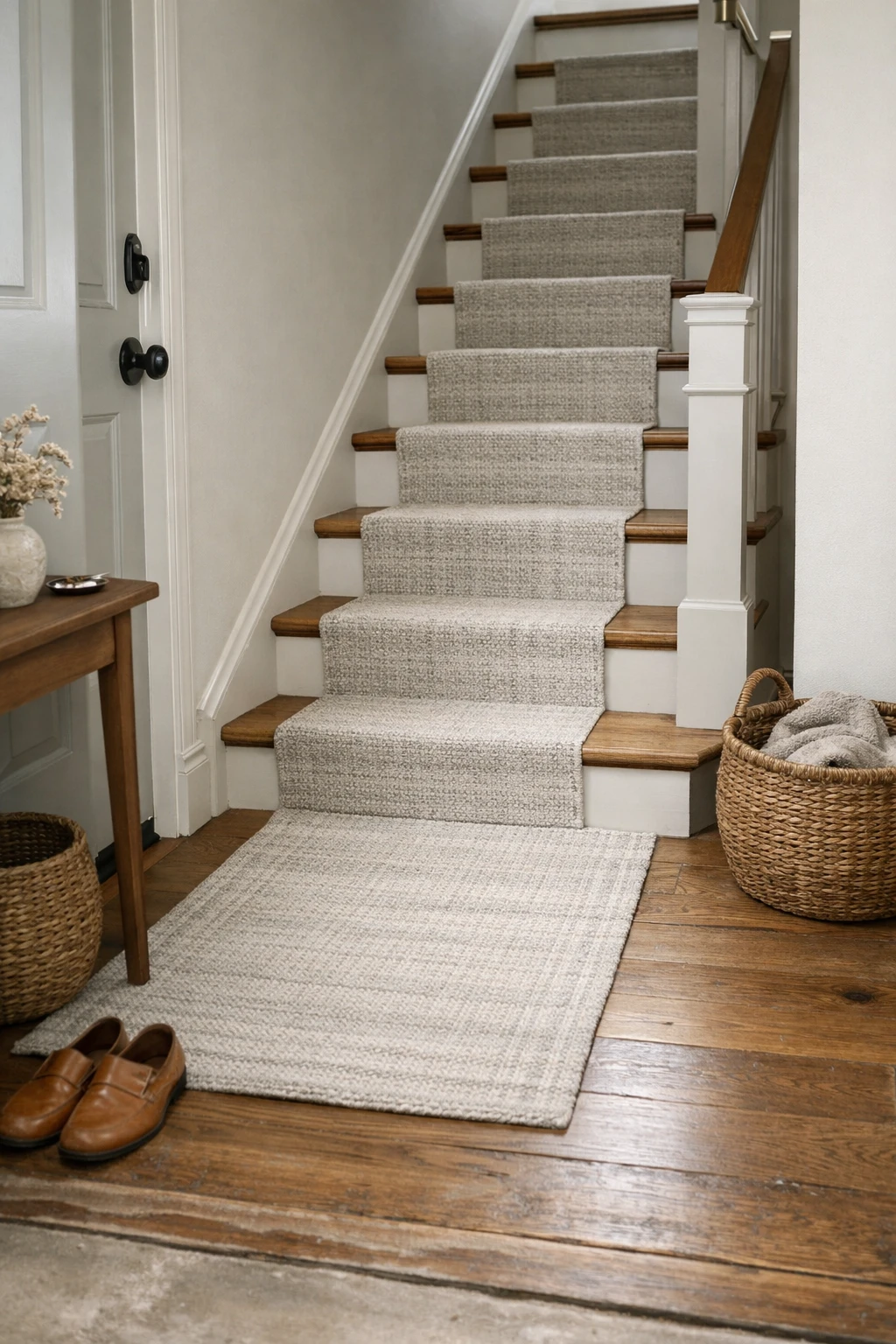
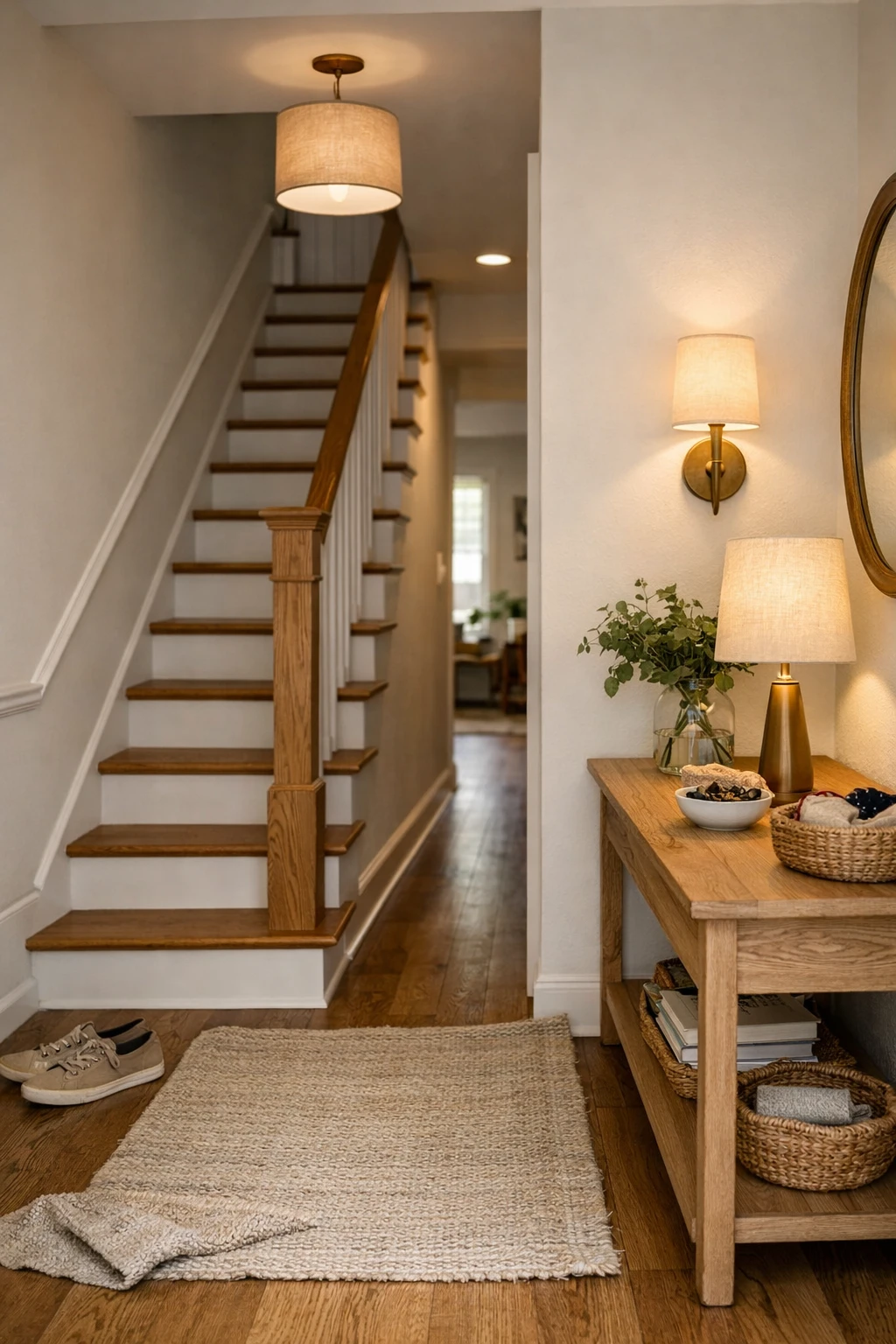
8. Install Sconces or a Small Pendant for Better Light
A narrow entry with stairs often suffers from uneven lighting. The stair wall can cast shadows, and the area near the front door can feel dim even during the day.
Better lighting fixes both function and mood. It helps people see what they are doing, and it makes the entry feel more welcoming.
Depending on the layout, good choices include:
- A pair of wall sconces above or near a console
- One small pendant centered in the entry
- A flush-mount ceiling light for low ceilings
- A table lamp on a slim console for softer evening light
Layered light works best when possible. Overhead light alone can feel flat and harsh. A small lamp or warm wall light adds depth.
9. Use the Stair Wall for Vertical Storage and Decor
When floor space is limited, the wall beside the stairs becomes valuable. This is where vertical planning matters.
That wall can hold:
- Hooks for coats or dog leashes
- A narrow ledge for keys and mail
- Framed art in a clean line
- A small wall organizer for daily essentials
The mistake people make here is trying to use the whole wall for everything at once. Hooks, gallery frames, floating shelves, baskets, and signs all stacked together usually look chaotic.
Pick one main function first. If you need storage, do storage. If you want style, do a clean art arrangement. Trying to make one narrow wall do five jobs rarely ends well.
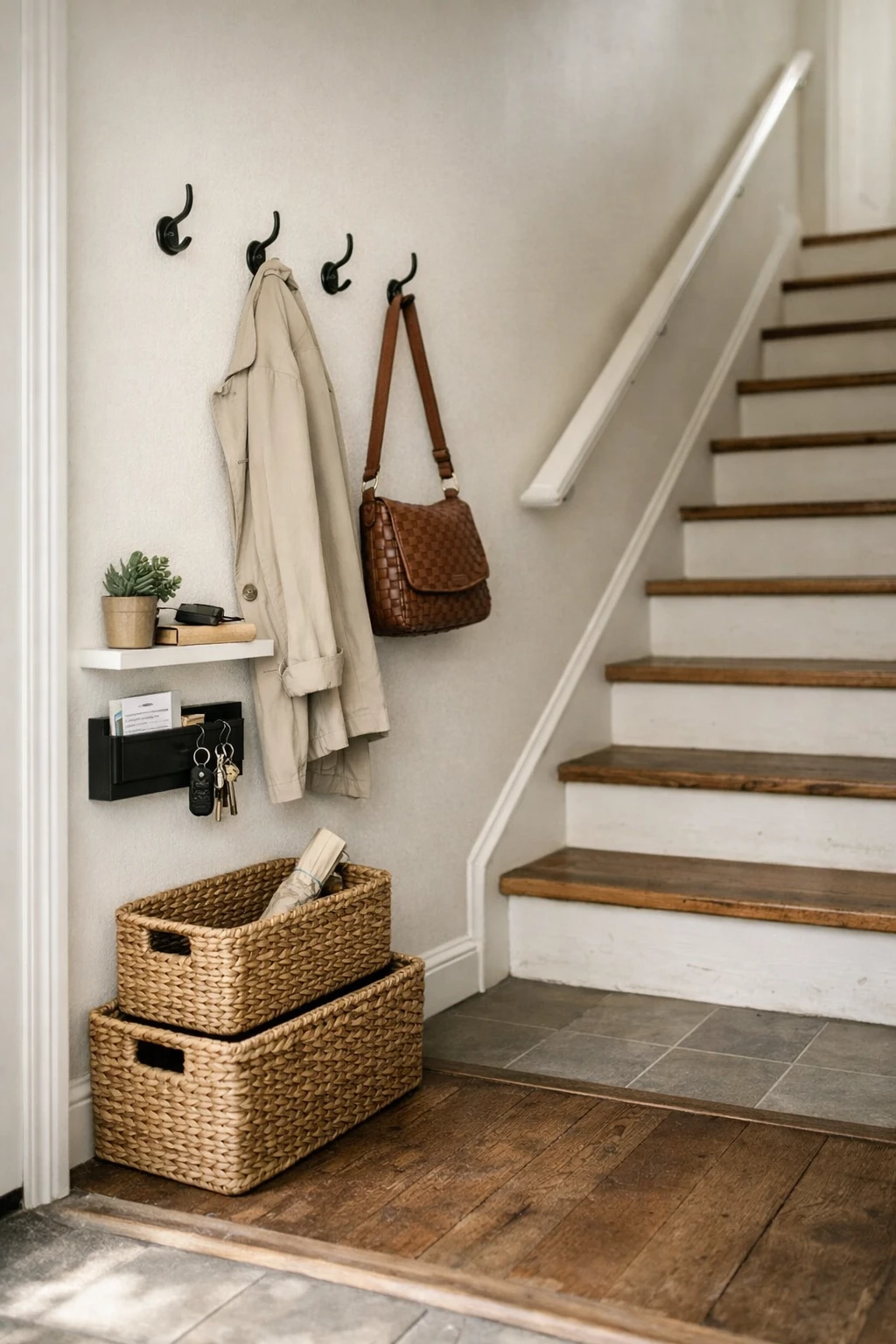
10. Create a Simple Drop Zone Near the Door
A drop zone keeps daily life from spilling across the whole entry. In a narrow space, this matters even more because clutter spreads fast.
Your drop zone does not need to be big. It just needs to be clear and repeatable. That could mean a tray on a console, one basket under a bench, and two hooks on the wall. Done right, that is enough for most households.
A useful drop zone often includes:
- A tray for keys and mail
- One shoe basket or hidden shoe drawer
- A hook for the bag used most often
- A small dish for loose items like earbuds or change
Without a defined landing spot, people dump things wherever there is an open corner. Then the entry stops looking styled and starts looking neglected.
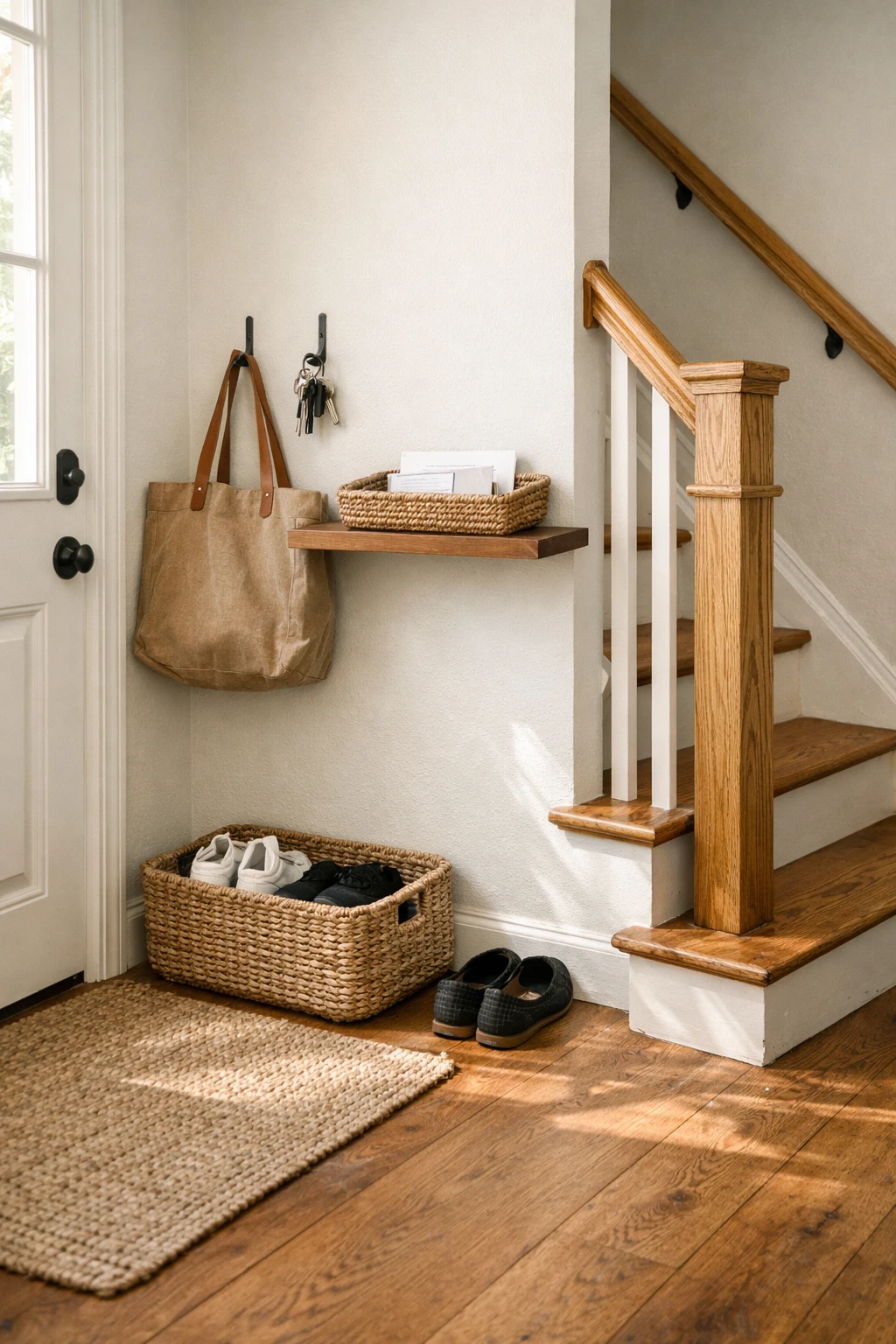
11. Keep Decor Tight and Intentional
This is where many narrow entryways go wrong. People know the space looks unfinished, so they start adding things. A sign, a basket, a candle, a stool, fake stems, a bowl, a mirror, extra hooks, more art. The result is usually worse than the original empty wall.
A narrow entry with stairs needs editing. It needs a few useful pieces and a little warmth, not a pile of small decor.
This table shows what usually works best in a tight stair entry:
| Element | Works Well | Usually Backfires |
|---|---|---|
| Entry furniture | Slim console, narrow bench, floating shelf | Deep table, bulky cabinet, oversized bench |
| Storage | Closed drawers, a few hooks, one basket | Open bins everywhere, crowded coat rack |
| Decor | One mirror, one lamp, one vase, simple art | Too many signs, layered objects, lots of tiny pieces |
| Color | Light neutrals, soft contrast, warm wood | Heavy dark walls in low light |
| Stair styling | Quiet runner, neat railing, clean lines | Busy patterns fighting for attention |
A good narrow entry does not need more stuff. It needs better choices.
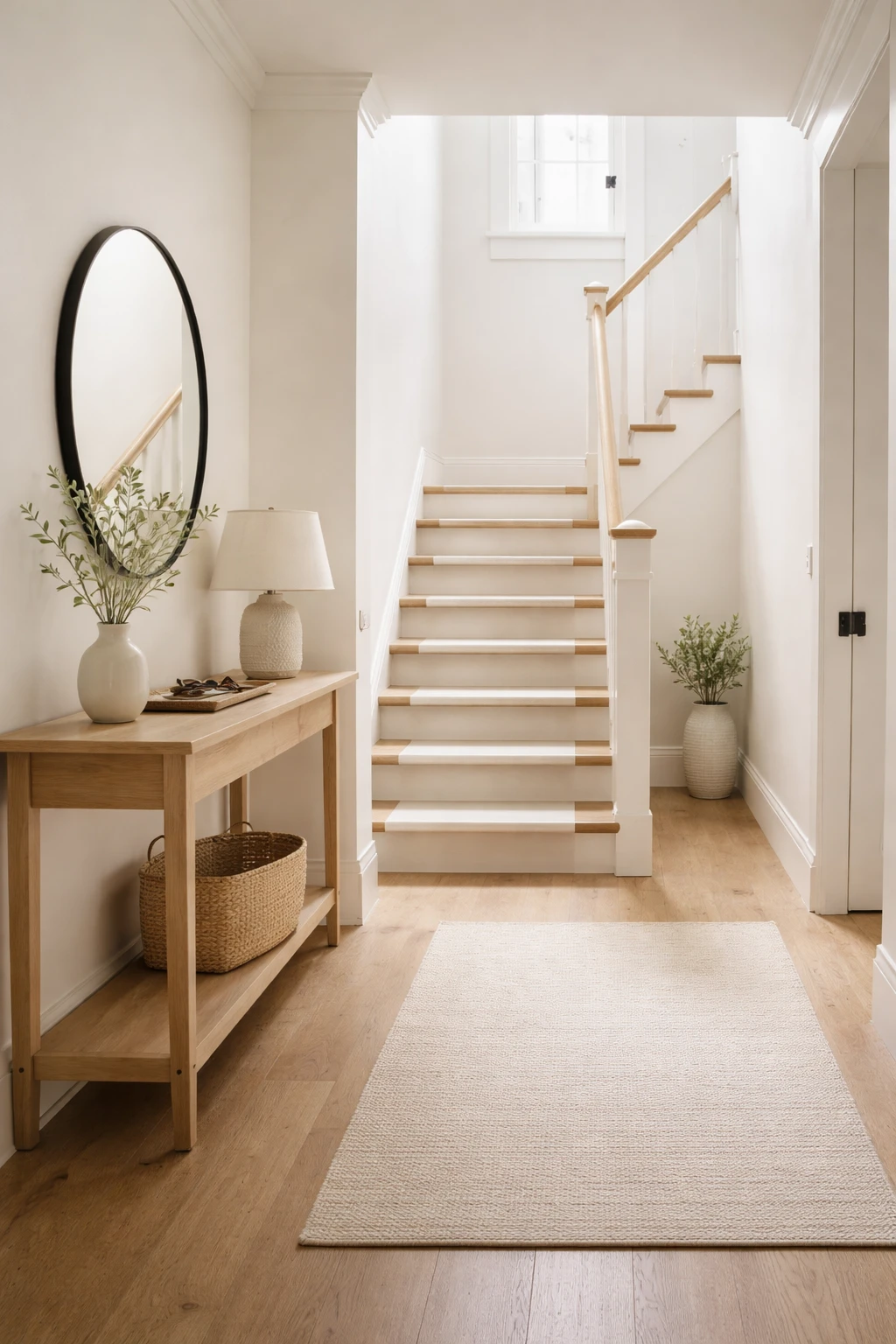
12. Choose Closed Shoe Storage Over Open Racks
Open shoe racks sound practical until real life hits. In a narrow entryway, visible shoes make the space feel messy almost right away. That is even more obvious when the stairs are right there in view from the front door.
Closed shoe storage keeps the entry calmer. A slim cabinet with tilt-out compartments works well in tight spaces because it holds more than it looks like it should. A bench with hidden storage can also do the job if the depth is right.
This is a better choice for homes that need the entry to look neat most of the time. It is not about pretending people do not wear shoes. It is about not letting footwear become the main visual feature of the room.
If you need daily access, keep one pair per person in use and move the rest elsewhere.
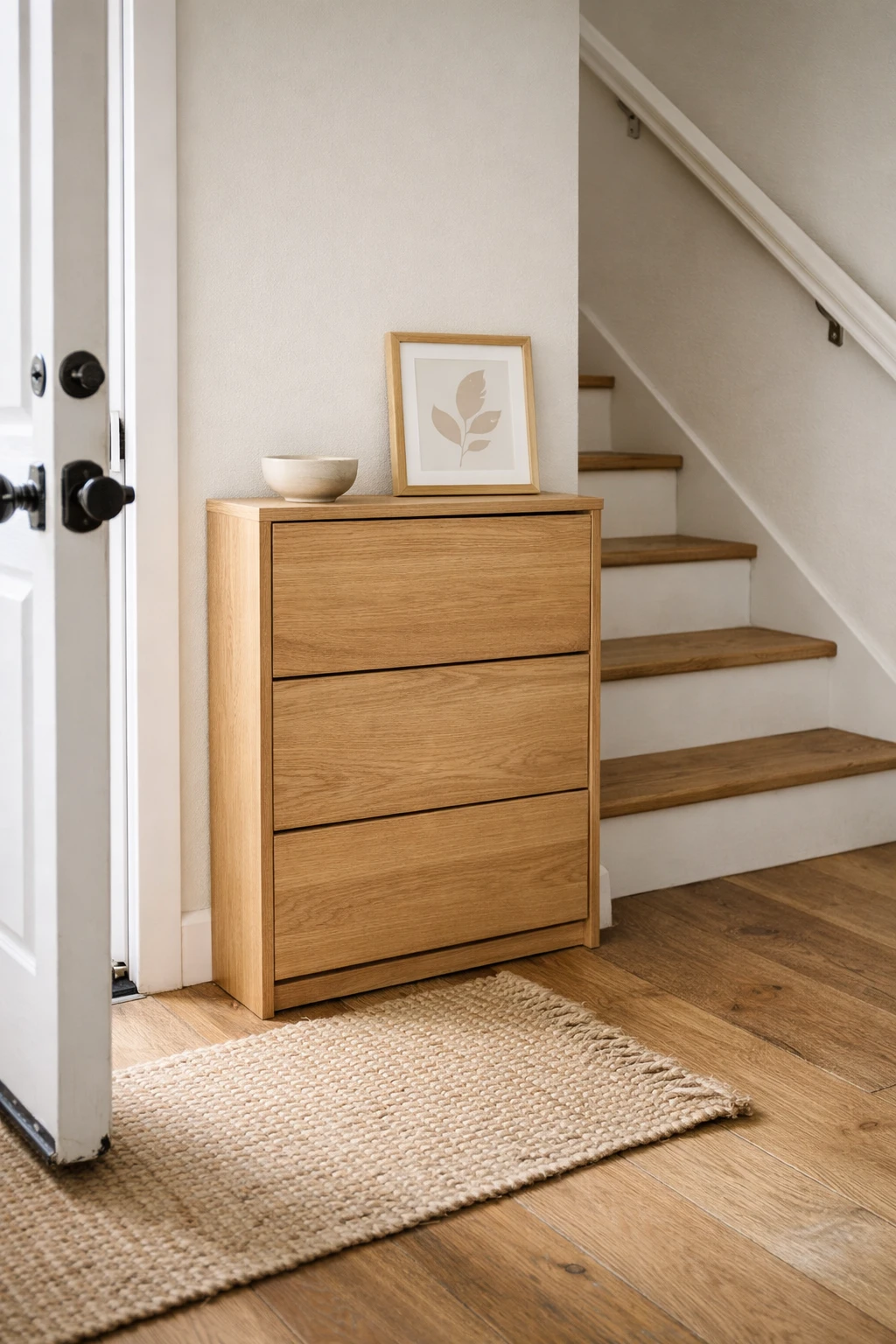
13. Use One Strong Piece of Art on the Stair Wall
A narrow entry does not need a complicated gallery wall just because the stair wall is big. That is one of the easiest ways to make the area feel too busy.
One larger piece of art often works better than many small ones. It gives the eye a place to land and keeps the wall from feeling scattered. This is especially helpful if the staircase already adds a lot of visual movement through rails, treads, shadows, and angles.
Good art choices for this kind of entry:
- Soft abstract landscapes
- Simple line art
- Black and white photography
- Calm botanical prints
The goal is not to fill every inch. It is to create balance. In a narrow space, restraint looks more expensive than overfilling the walls.
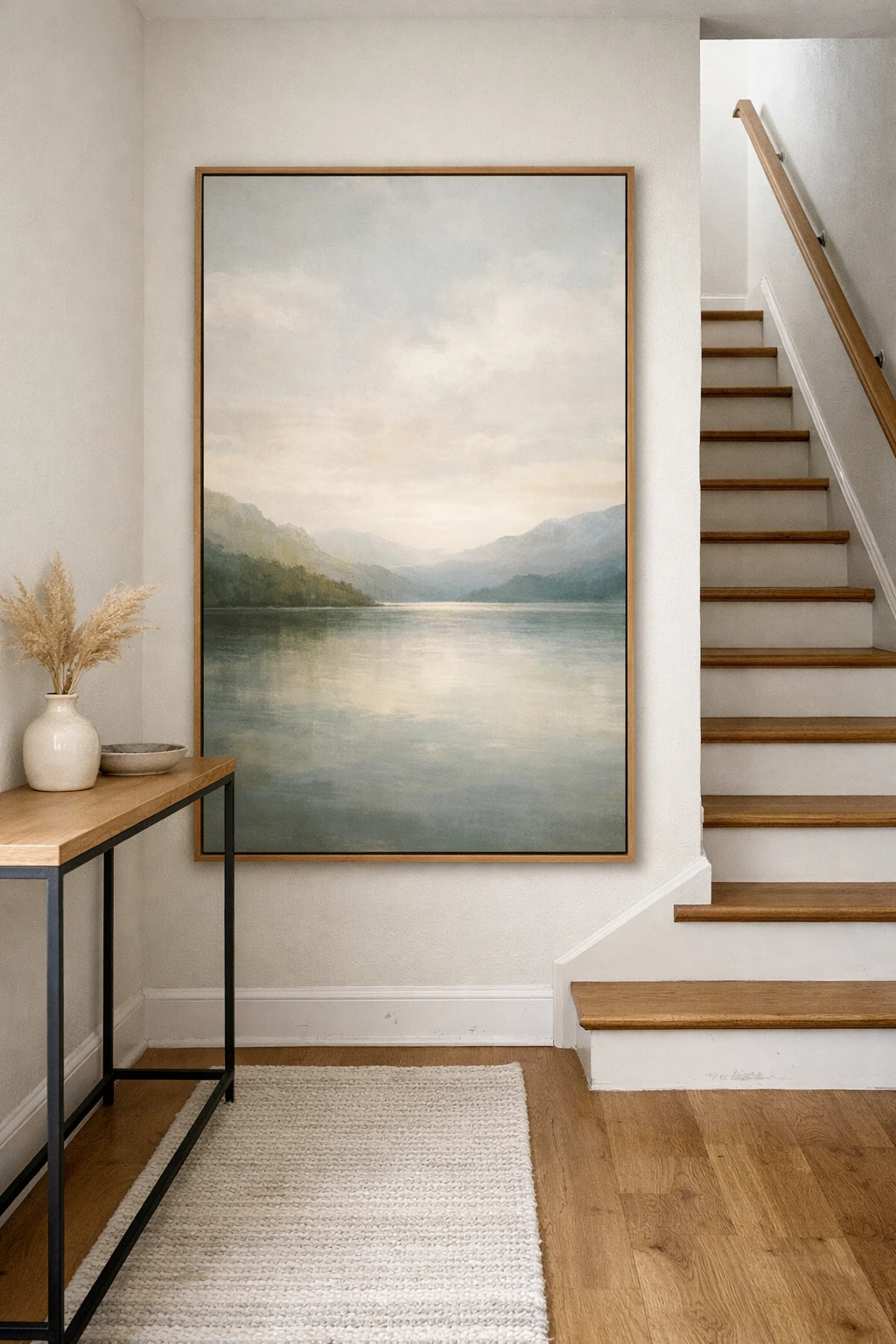
14. Float a Shelf Instead of Using Full Furniture
If the entry is so tight that a console table feels risky, use a floating shelf. It gives you the function of an entry table without the weight of a full piece of furniture.
A shelf can hold keys, a small bowl, and one compact lamp or vase. It also keeps the floor visible, which helps the whole area feel more open. In homes where the stairs come down close to the front door, that extra visual breathing room matters.
A floating shelf works best when:
- The wall is too narrow for a normal console
- You need a place for essentials only
- The entry already has enough storage elsewhere
- You want a cleaner, more modern look
Keep it simple. If the shelf starts collecting piles of mail, receipts, and random clutter, it stops helping.
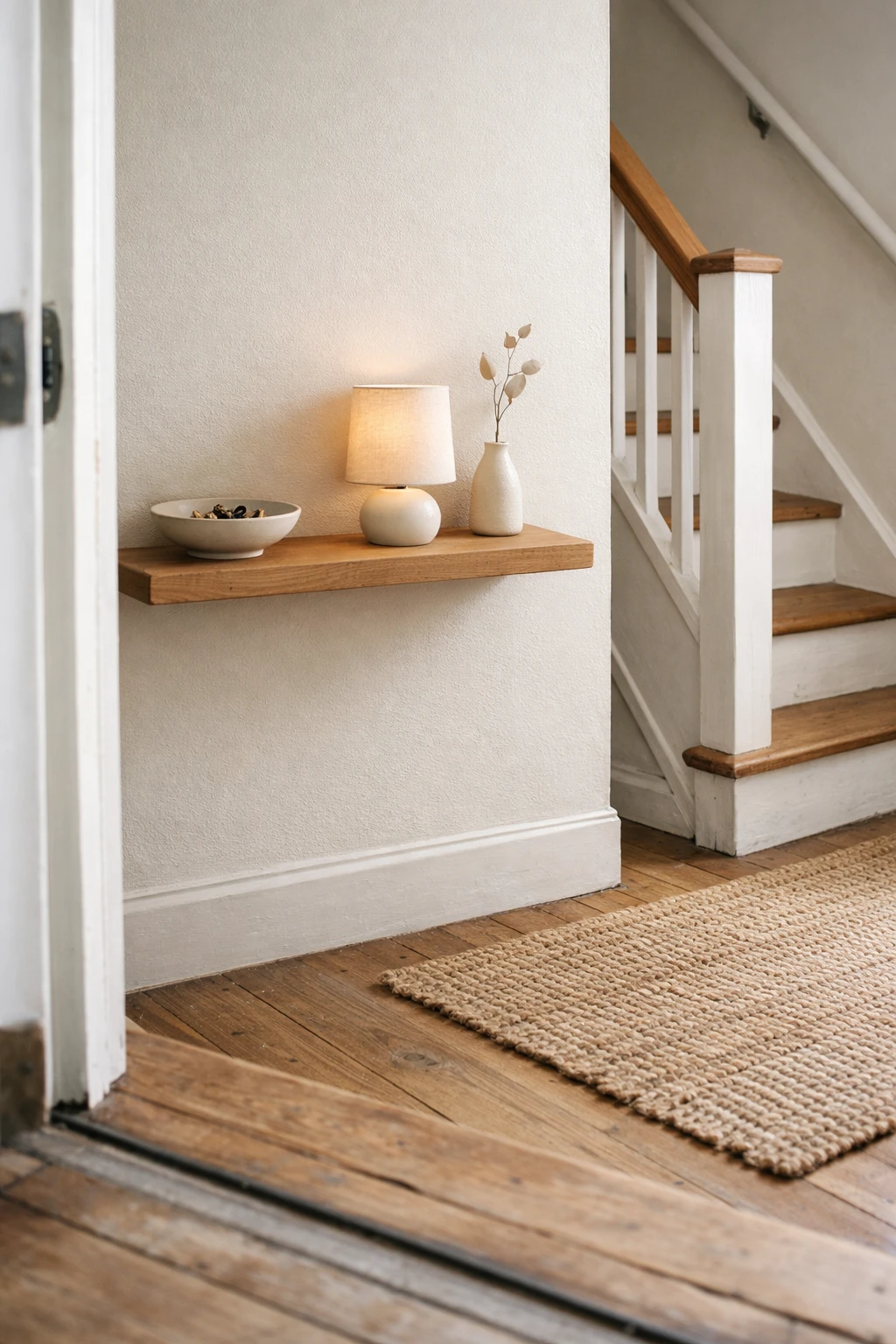
15. Match the Entryway Style to the Staircase
A lot of narrow entryways look off because the entry decor and the staircase feel like two separate ideas. The front door area might look modern, while the stairs feel traditional. Or the entry is soft and neutral, while the staircase is dark and heavy.
That disconnect makes the space feel less finished.
Bring the two parts together by repeating at least a few shared elements:
- The same metal finish on hooks and stair hardware
- Similar wood tones between furniture and stair treads
- A runner that connects with the entry rug or palette
- Paint colors that make the stair trim feel intentional
This does not mean everything has to match exactly. It means the entry and stairs should look like they belong to the same house and the same room.
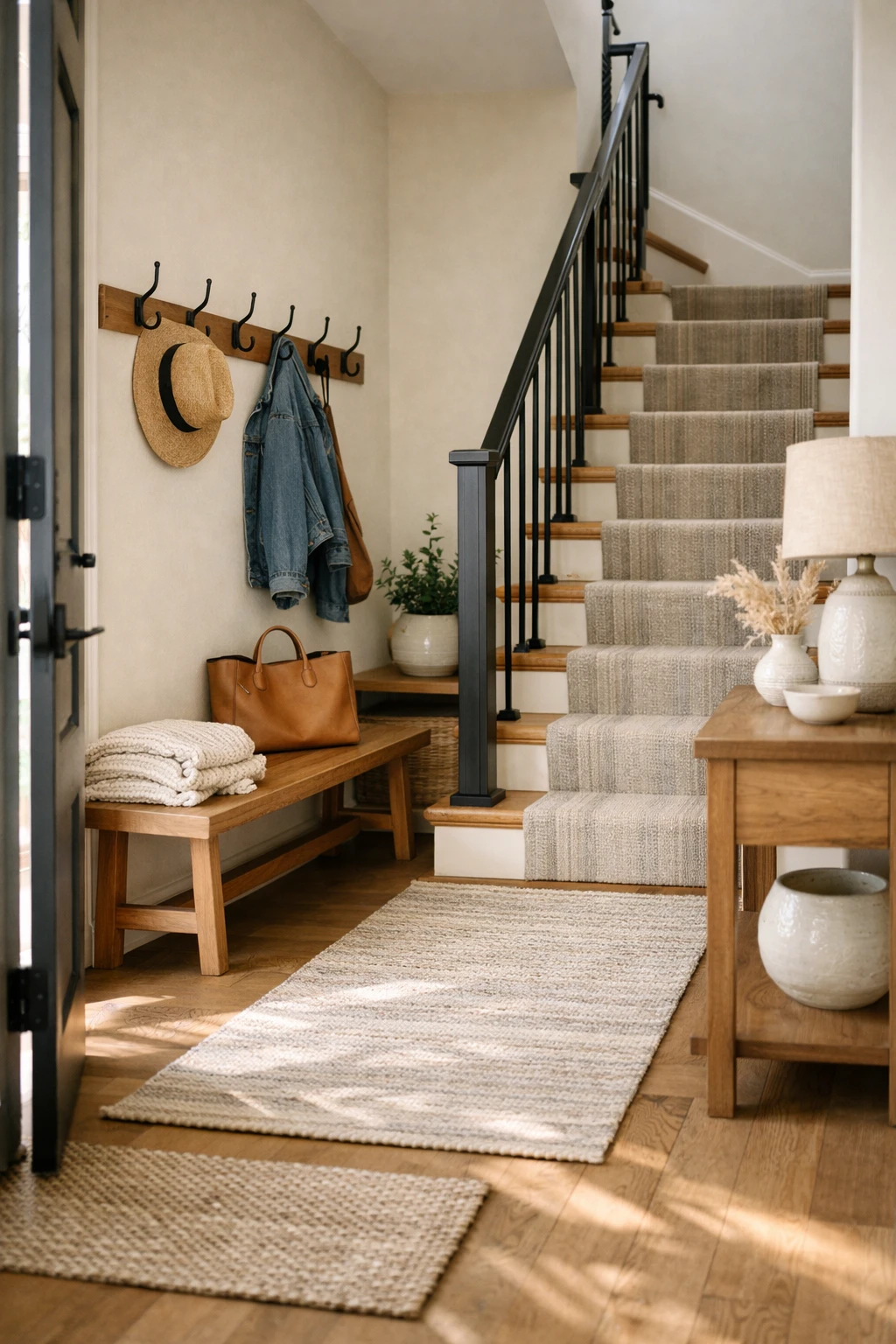
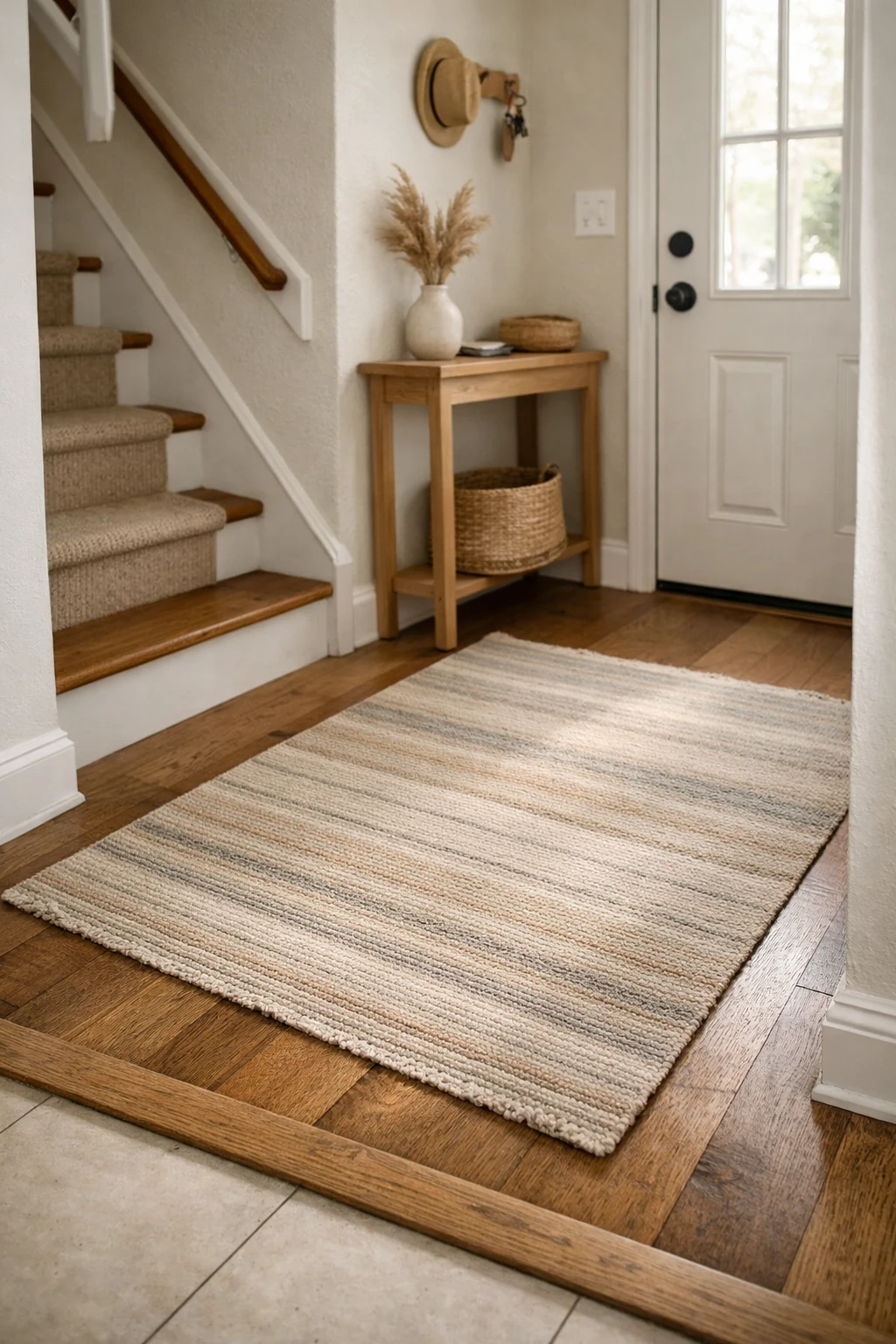
16. Add a Small Rug That Defines the Door Area
A rug helps ground the entry and signals where the drop zone starts. In a narrow entryway, it can also help the space feel less like a pass-through hallway and more like a real part of the home.
The rug needs to fit the footprint. Too small and it looks random. Too large and it crowds the door swing or fights with the bottom stair.
Flatweave and low-pile rugs are usually the best fit because they are easier to clean and less likely to bunch up in a high-traffic area. Patterns can help hide dirt, but keep them quiet if the staircase already has a runner.
A good entry rug should do three things:
- Handle dirt and traffic
- Add softness
- Support the room without taking over
If it slips, curls, or jams against the door, it is the wrong rug no matter how pretty it looks.
17. Use Baskets Carefully, Not Everywhere
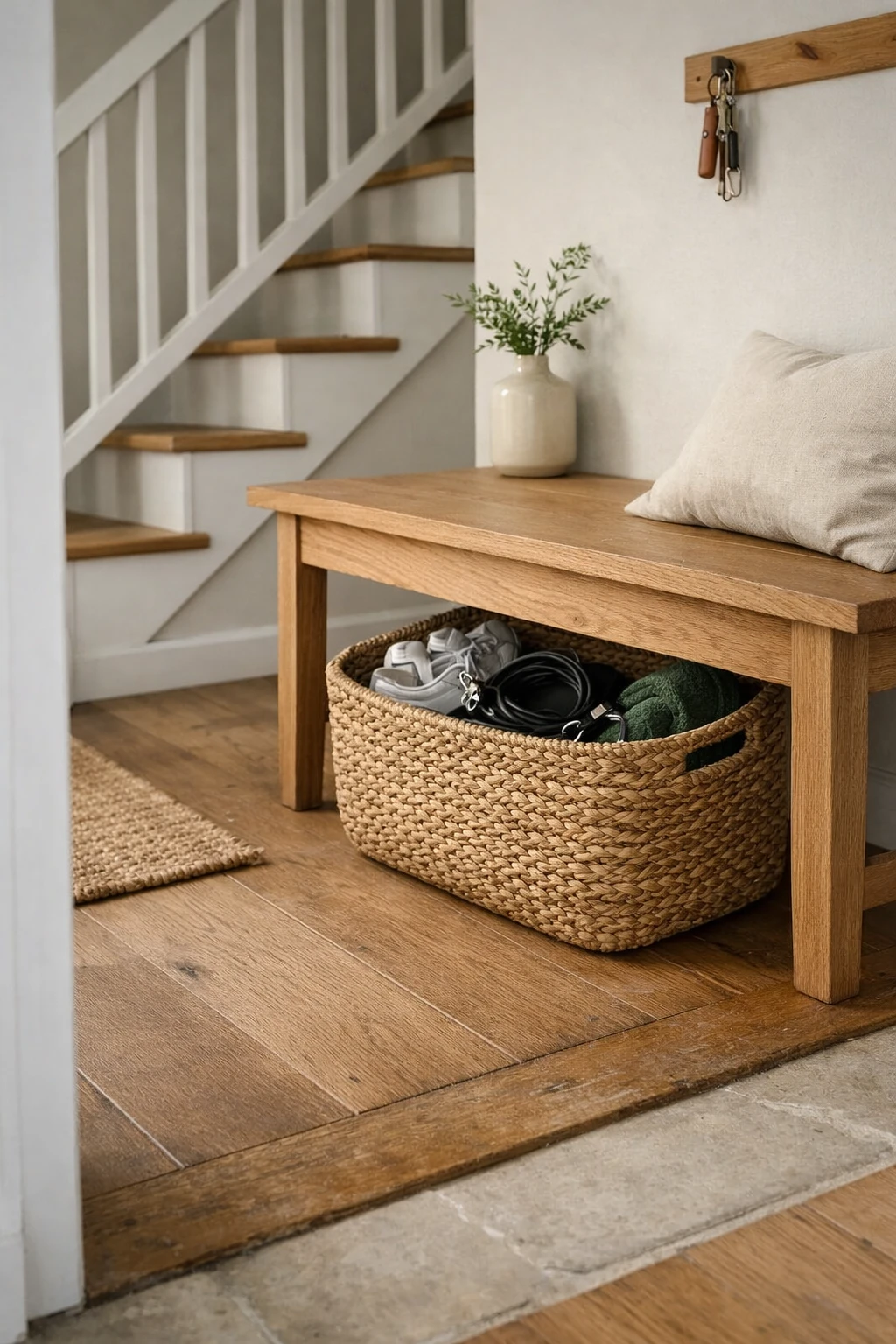
Baskets are useful, but people overuse them in entryways. One basket can look tidy. Five baskets in a narrow hall just look like storage on display.
Use baskets only where they solve a clear problem. One under a bench for shoes or one under a console for scarves and dog gear can make sense. More than that usually starts to feel cluttered.
The best basket choices for a narrow entry are:
- One medium woven basket under a bench
- One structured basket under a console
- One lidded basket if you want a neater look
If every loose item gets its own basket, the entry turns into a storage aisle. Hidden storage is almost always better when square footage is tight.
18. Keep the Bottom of the Stairs Visually Clean
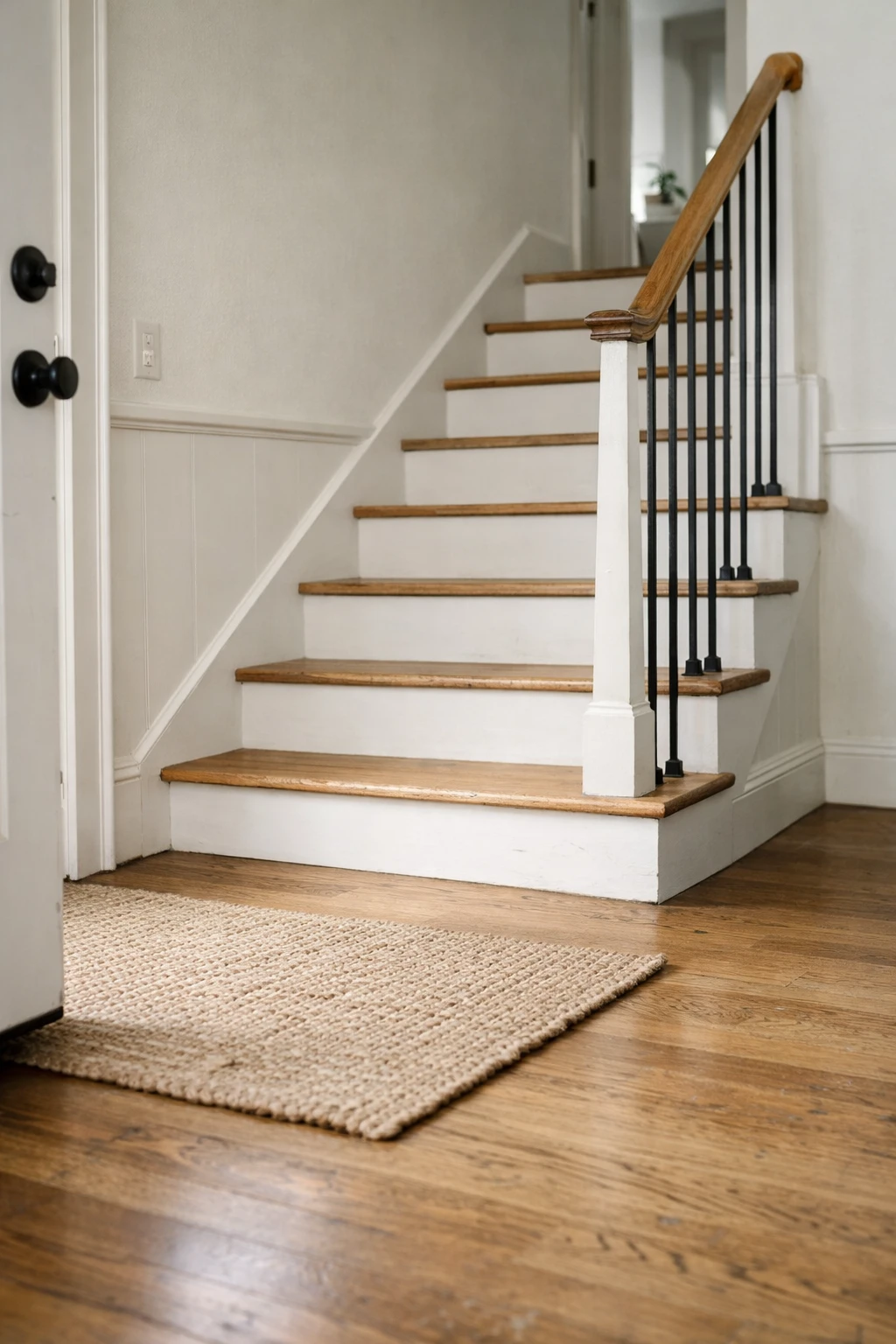
The base of the staircase sets the tone for the whole entry. If shoes, bags, decor, and random items gather there, the space immediately feels cramped.
This is where discipline matters more than decorating. You can have nice hooks, a pretty runner, and good lighting, but if the bottom stair becomes a dumping ground, none of that will matter.
A few rules help:
- Do not store loose items on stair treads
- Do not lean frames or signs against the stair wall
- Do not let the first few steps become extra shelving
- Keep the stair landing area clear
People often treat the bottom of the stairs like temporary storage. Temporary usually becomes permanent. Keep it empty on purpose.
19. Bring in Warm Wood to Keep the Entry From Feeling Flat
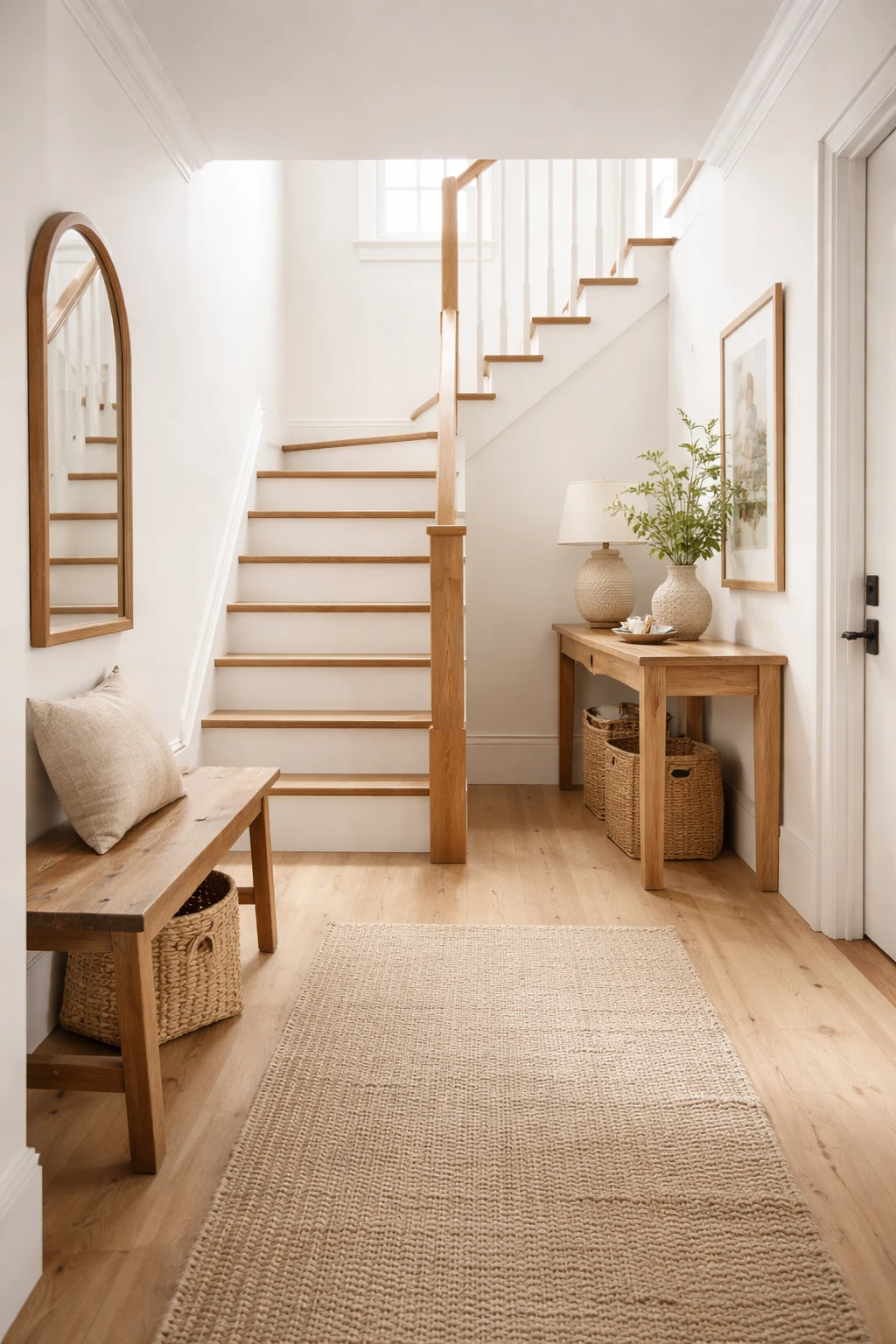
A narrow entry with light walls can look fresh, but it can also start to feel plain if every surface is cold or smooth. Warm wood helps fix that.
A wood console, bench, frame, or stair detail adds texture and keeps the entry from looking washed out. This works especially well in homes with white walls, black metal railings, or pale tile floors.
You do not need a lot of it. One or two wood elements are enough to warm up the space. What matters is balance. If the staircase already has strong wood tones, repeat that tone somewhere nearby so the entry feels connected.
Natural materials make a small space feel more grounded. They also age better than trend-heavy finishes.
20. Use the Vertical Height to Your Advantage
Many narrow entryways are short on width but decent on height, especially near a staircase. That vertical space is useful. It can make the room feel larger if you handle it well.
A tall mirror, higher-mounted art, longer drapery near the door, or a vertical wall sconce can draw the eye up and help the space feel less compressed. This is one of the easiest ways to make a tight area feel more balanced.
Just do not confuse vertical styling with overfilling the wall. You want height, not clutter.
Strong ways to use height:
- Hang art with enough scale
- Use a tall mirror instead of several small frames
- Install a pendant or lantern if ceiling height allows
- Add a tall branch arrangement in a simple vase
The idea is to stretch the room visually, not to stack objects from floor to ceiling.
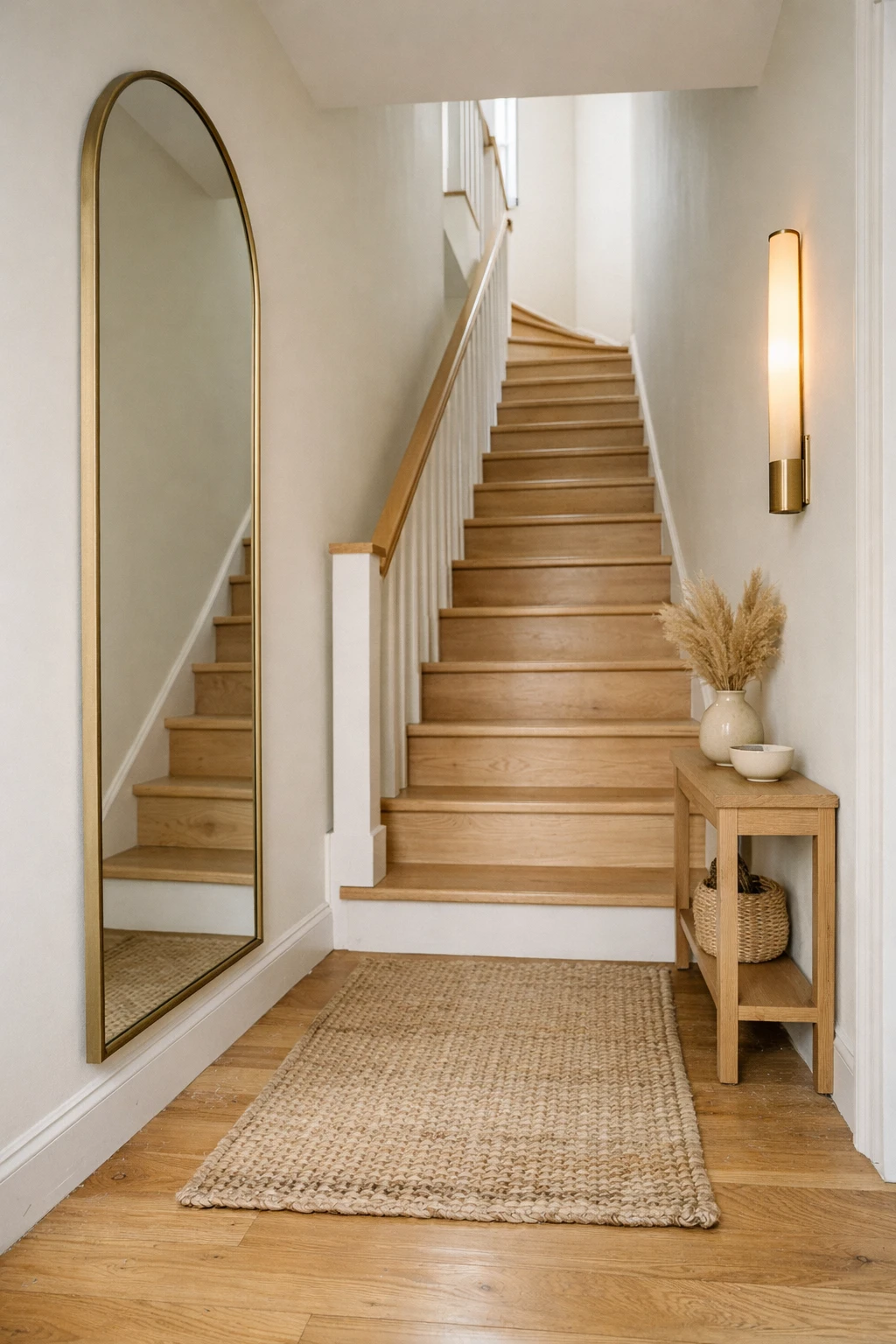
21. Edit the Entryway Like It Has to Earn Its Space
This is the idea that ties all the others together. In a narrow entryway with stairs, every item needs a reason to be there. If it does not add function, support the layout, or improve the look in a clear way, it is probably in the way.
That sounds harsh, but it is true. Small spaces punish bad decisions faster than big rooms do.
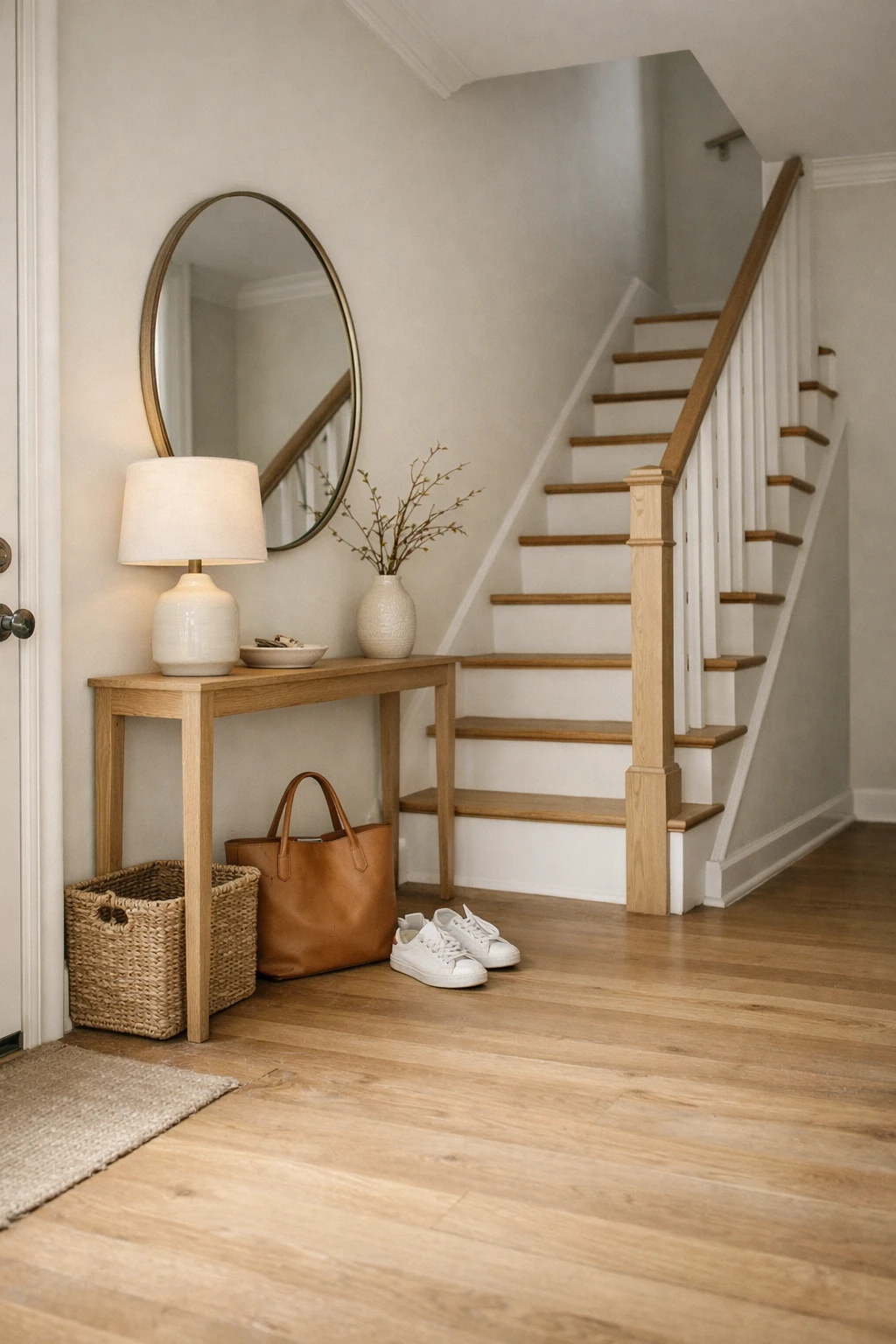
Final Words
A good final edit should ask:
- Does this item block movement?
- Does it solve a daily problem?
- Does it make the space feel lighter or heavier?
- Would the entry look better without it?
The best narrow entryways are not filled better. They are edited better. That is what makes them feel calm, useful, and attractive at the same time.
A narrow entryway with stairs will probably never feel huge. That is not the goal. The goal is to make it function well, look intentional, and stop working against the rest of the house. When the layout stays open, the storage makes sense, and the stair area feels connected to the decor, even a small entry can make a strong first impression.